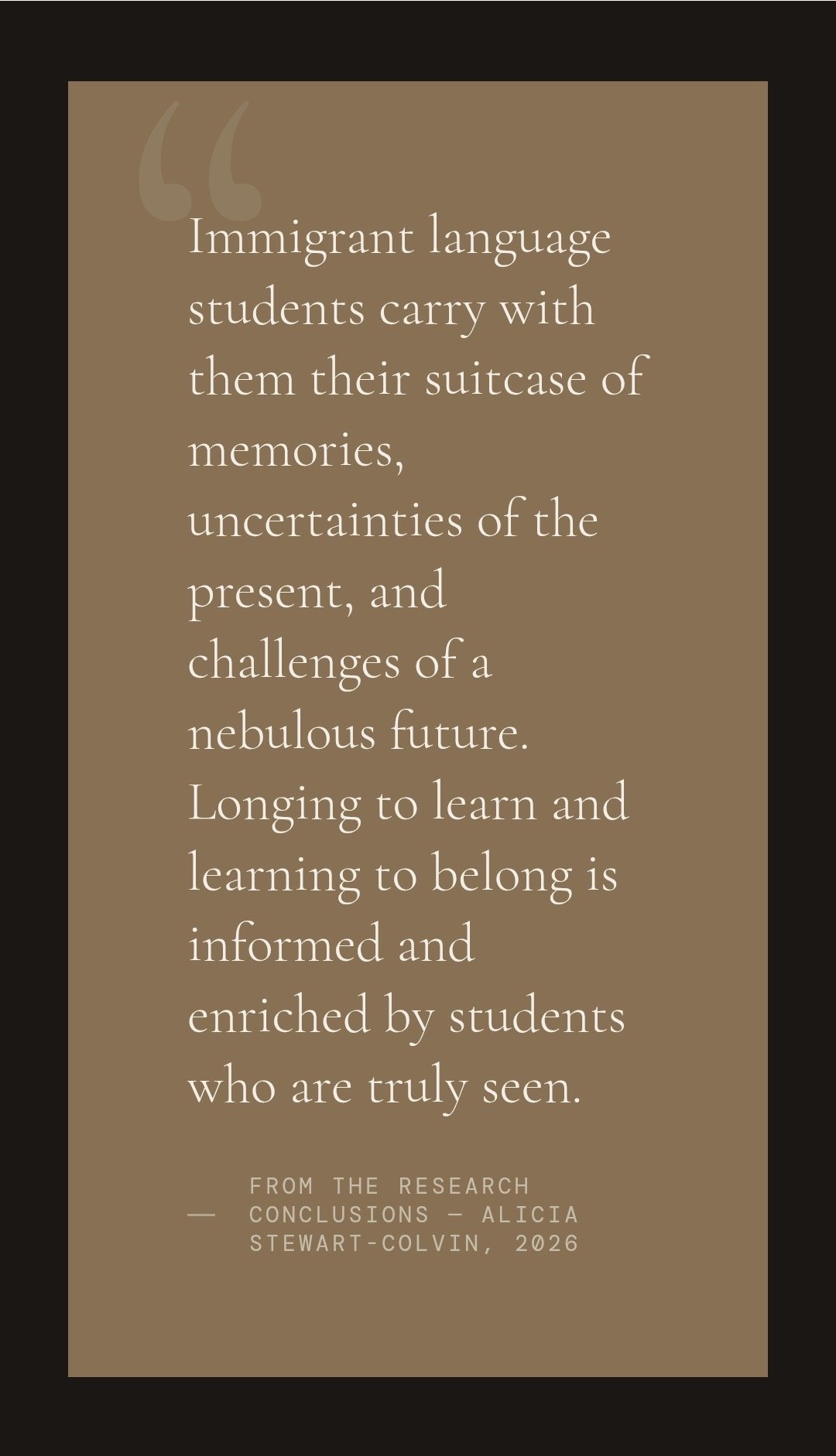
Longing to Learn, Learning to Belong: An Ethnographic Study on Identity and Heritage Among Immigrant Language Students in Western Uusimaa, Finland.
Over seven months, I conducted deep qualitative research into how language learning shapes identity and belonging among immigrant communities. Working across interviews, observation and cultural analysis, I examined the psychological, social and political dimensions of language acquisition — and what it means for how people locate themselves in the world.
The research was awarded a distinction by the University of Abderdeen.
It changed how I think about communication, culture and what it means to truly understand an audience. It also confirmed something I'd suspected for years: that the most interesting strategic questions are always, underneath everything, human ones.
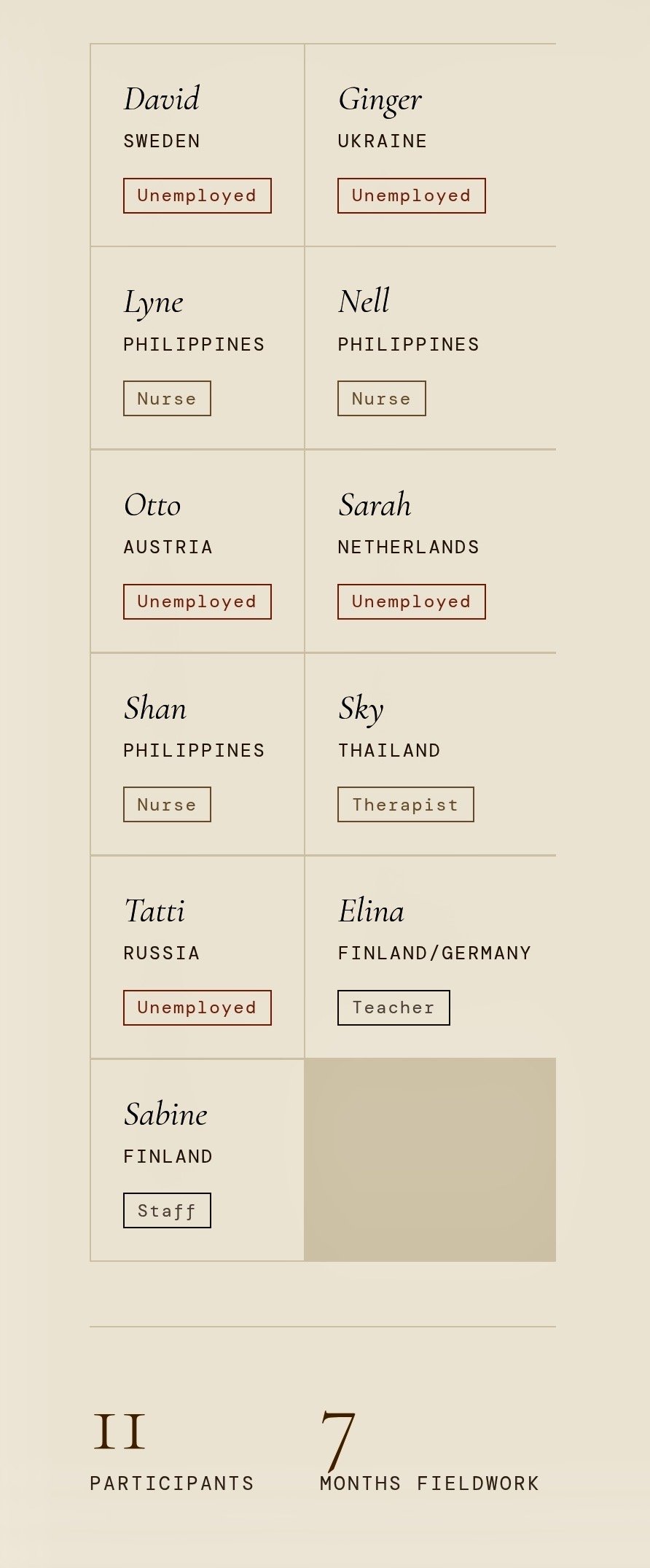
participants (pseudonyms)
the approach
I didn’t go in with a hypothesis. I went in every Wednesday to understand.
For seven months I sat in the classroom and observed participants. I interviewed people. I watched the same people navigate the same impossible task – becoming legible in a language that wasn’t theirs – and wrote down everything I noticed. The small victories. The quiet humiliations. The moment a student stopped raising her hand. The moment another one started to. I followed ethnographic hunches. I let the findings come to me rather than imposing a framework.
Ethnography is slow work. It resists the urge to conclude too quickly. It asks you to sit with uncertainty long enough for something true to emerge. That discipline – staying present, resisting easy answers, letting the humans in the room tell you what matters – is the same discipline I bring to every organisation I work with. The most important things are almost always never said aloud. You have to be in the room long enough to hear them.
themes


what this means for organisations
Learning a new language under institutional pressure is one of the most revealing human experiences there is. It strips away professional identity, social confidence and cultural fluency simultaneously — and forces a person to rebuild all three in real time, in a system that wasn't designed with them in mind.
What I observed in that classroom has direct implications for any organisation thinking seriously about culture, belonging and change: when people feel institutionally invisible — when their prior expertise goes unacknowledged, when the system doesn't know how to hold them — they don't leave. They stay and make themselves smaller. That contraction costs organisations enormously in ways that never show up on a dashboard.
The conditions that created belonging in that classroom were never the formal structures. They were the moments when a teacher asked about someone's life. When a student's professional history was recognised. When the curriculum bent slightly toward the human rather than demanding the human bend entirely toward the curriculum.
Innovation labs and ecosystem organisations are building the conditions in which new ideas, new people and new ways of working either take root or don't. The research suggests that belonging — real belonging, not the performative kind — is the precondition for everything else. You cannot innovate in a room where people don't feel safe enough to think out loud.